
On this page
Record the currency printed on the receipt
Choose the trip ledger, then enter the amount and currency for each purchase. If the guesthouse charged JPY 32,000, record JPY 32,000. If a flight cost CNY 2,400, record it in CNY.
The currency code matters. Yen and yuan can both use a ¥ symbol, so a screenshot showing ¥32,000 without a code can be ambiguous. Check the currency field alongside the amount, especially when reviewing a recognized receipt.
The pictured sample is called Japan, Slowly. It has four records and three participants. It uses CNY as its main currency and preserves the Japanese amounts in JPY.
Four records, two currencies
| Purchase | Original amount | Amount in CNY |
|---|---|---|
| Kyoto Guesthouse | JPY 32,000 | 1,600 |
| Dinner by the Kamo | JPY 4,200 | 210 |
| Trains and Buses | JPY 2,800 | 140 |
| Return Flights | CNY 2,400 | 2,400 |
| Total | JPY 39,000 + CNY 2,400 | 4,350 |
Swipe the table to see every column.
The three yen purchases total JPY 39,000. At the example rate shown in the ledger, 39,000 × 0.05 = CNY 1,950. Add the CNY 2,400 flight and the trip total is CNY 4,350.
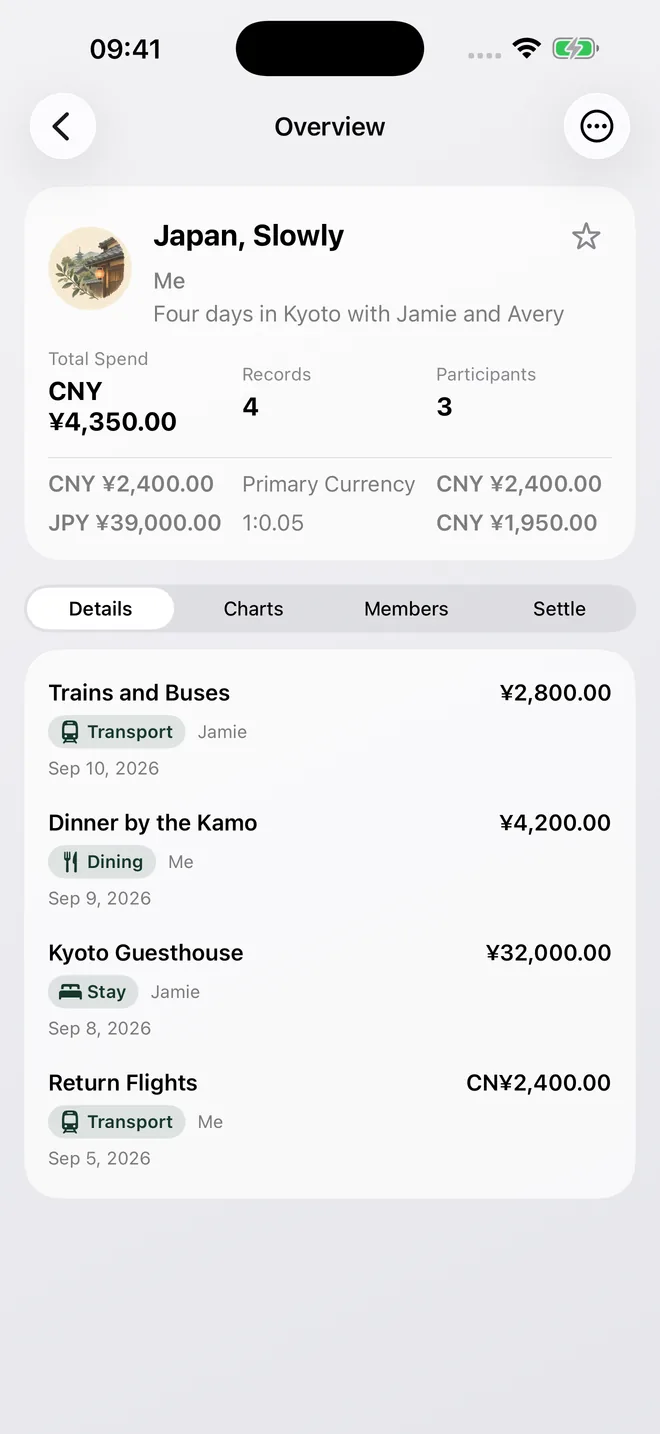
Read the conversion before comparing totals
The summary separates the main-currency purchases from the JPY purchases and shows the conversion used for the latter. Read that conversion when checking the total. Adding 39,000 and 2,400 directly would mix currencies and produce a meaningless number.
Your card statement may show a different converted charge, including the rate or fees used by the card provider. Decide which amount you intend to record. A ledger's conversion is not proof of the amount charged by your bank.
When your total differs from someone else's notes, check the original amount, the chosen currency, the conversion in the ledger and the date range. Keep a receipt or a note when it explains the difference.
Currency and participants are separate choices
After entering the amount and currency, choose who paid and who shared that purchase. A different currency does not mean every traveler should take part in the expense. A meal for two people should use those two participants even if the trip has three members.
The four-record screen shows the original amounts and combined trip total. It does not show that all three participants share every record equally. Review each record's participants before dividing the overall total.
If you scan a Japanese receipt, compare the draft with the original before saving it. A correctly read number in the wrong currency will distort both the summary and any resulting balances.
Review the shared book before arranging payment
Open Overview to find the original entries and the main-currency summary. Use Settle to review calculated balances after checking the payers and participants. The single-currency trip example explains how paid amounts and shares become a balance.
Shared ledgers and syncing require an active Basic owner. Invited travelers can join without their own Basic subscription. The app records expenses and calculates suggested balances; arrange the actual payment separately.
For this sample, the result to check is JPY 39,000 kept as JPY, CNY 2,400 kept as CNY, and CNY 4,350 shown as the combined total. That lets you read both the local purchases and the overall trip without losing their original currencies.